
DVA Claims — Diagnosis Forms + Diagnostic Assessments
DVA claims that get accepted. The entire process — from Chart Review, through imaging, to the Diagnosis Forms and Diagnostic Assessments, all written upfront — represents the gold standard in writing DVA claims in Australia.
At a glance
- Chart Review$600 + GST
- Forms & assessments — documented conditions$600 + GST
- Examination & investigation$600 + GST
- Forms & assessments — new conditions$600 + GST
- Commission on your payout0%
What is a DVA claim assessment?
A DVA compensation claim is decided on medical evidence measured against a Statement of Principles — the legal instrument that sets out what must be proven to link a condition to service. The Veterans Health Centre reads every page of your ADF and post-service medical record, identifies every claimable condition in it, and writes a Diagnostic Assessment for each one that addresses every SoP factor against your own service history and clinical record. Four stages, $600 + GST each, quoted in writing and never a percentage of your compensation. Claims are prepared under MRCA, DRCA or VEA.
Dr Thomas Perkins
The expert in veterans’ medicolegal medicine — Expert DVA Doctor.
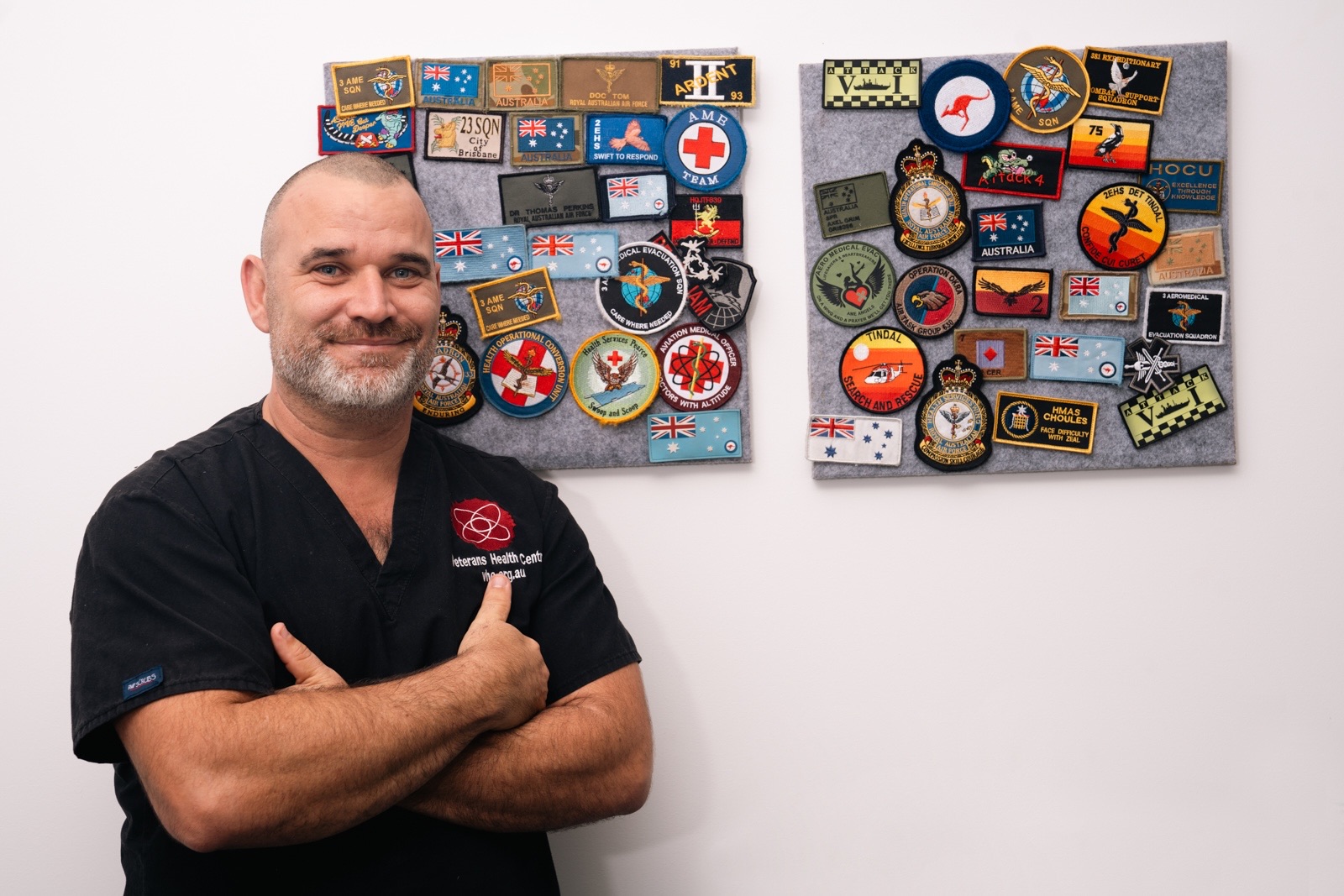
Dr Thomas Perkins is the founding doctor at the Veterans Health Centre in Ipswich, Queensland, and the leading expert in veterans’ medicolegal work in Australia. He has spent over 13 years working exclusively with current and former Australian Defence Force members — treating conditions, writing reports, and navigating the DVA system alongside them.
With 80,000+ DVA claims submitted and over 2,000 Permanent Impairment Assessments completed, Dr Perkins brings a depth of experience that simply cannot be replicated from a textbook. He understands the Statements of Principles, the GARP tables, the imaging that proves what a physical examination alone cannot — and the difference that a properly written report makes at every level, from initial liability through to the VRB.
Every chart review, every diagnostic assessment, and every impairment rating is personally overseen by Dr Perkins. If you’re looking for a doctor who knows veterans medicine inside and out, you’ve found the right clinic.
DVA Reports written with precision.
The difference is the report. DVA decides on the document in front of them — every condition named, every SoP factor addressed, every finding referenced to the file. That is the work of an Expert DVA Doctor, not a template.
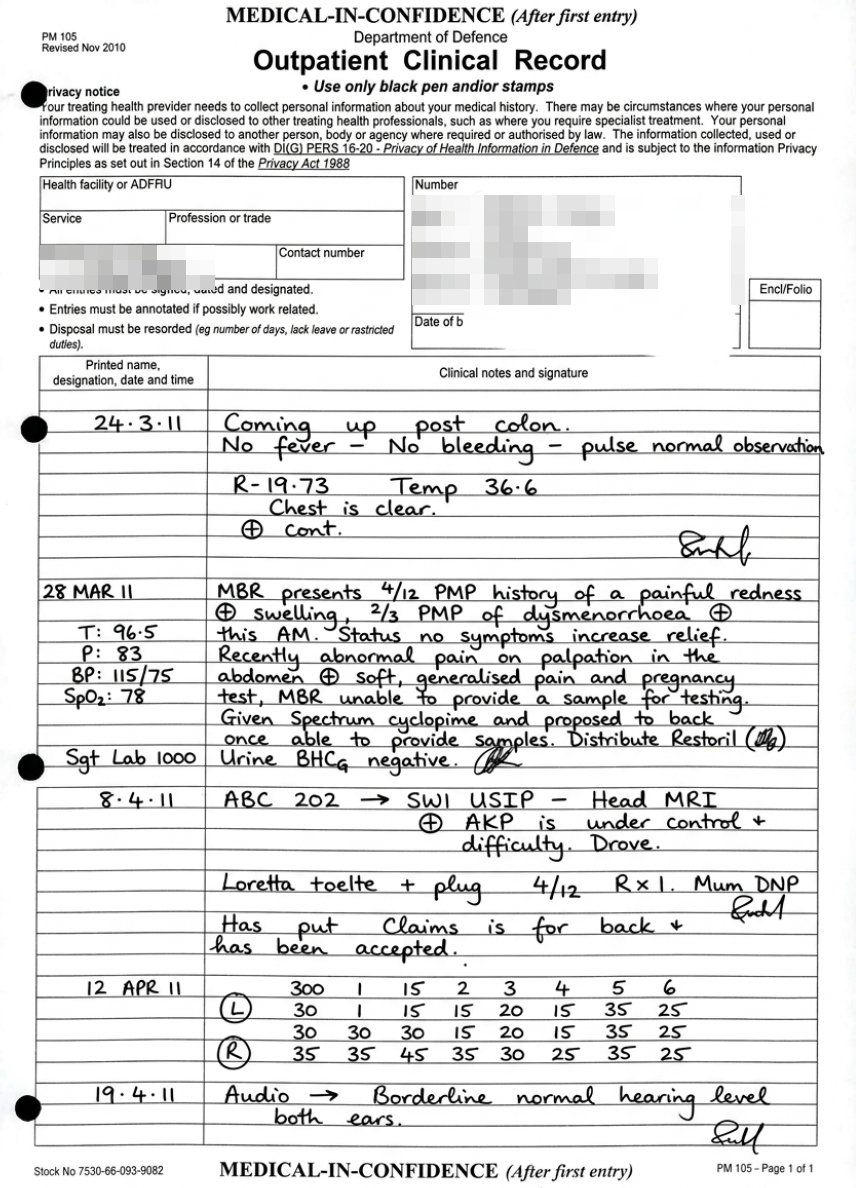
Chaotic records
Your file arrives as thousands of pages — handwritten PM 105 notes, scanned forms, imaging, and clinical shorthand. Injuries are buried in entries nobody has ever read end to end.
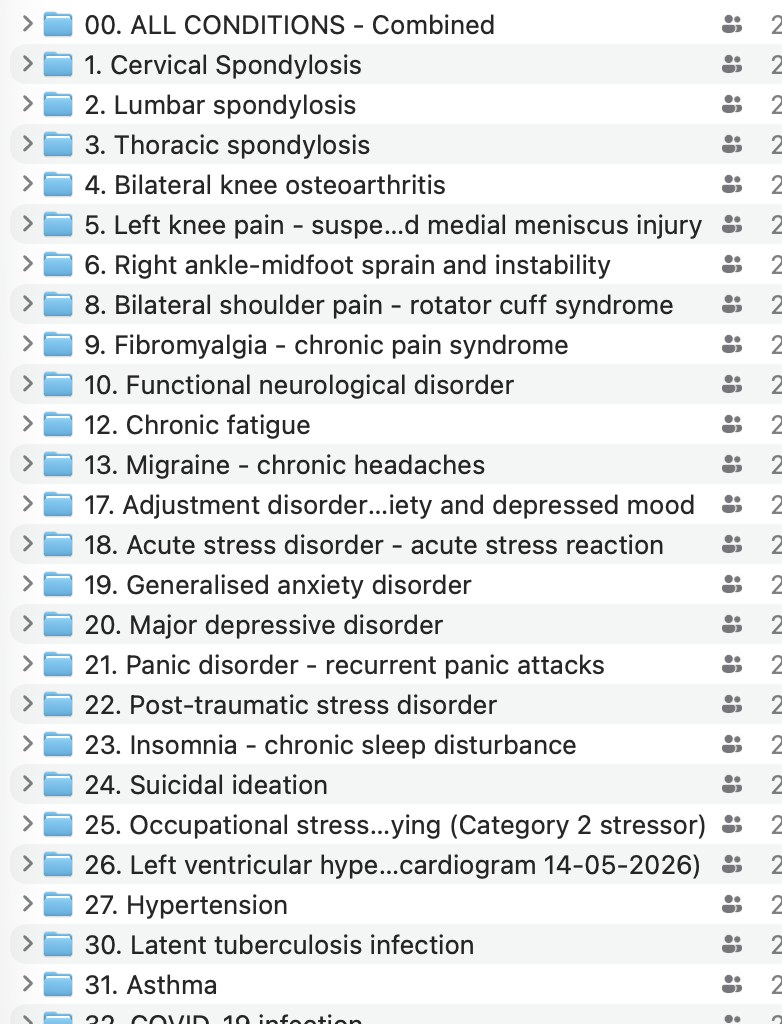
Organised by condition
The Chart Review reads every page and sorts every finding into a numbered condition folder — each with the source pages that prove it, and its DVA Statement of Principles identified.
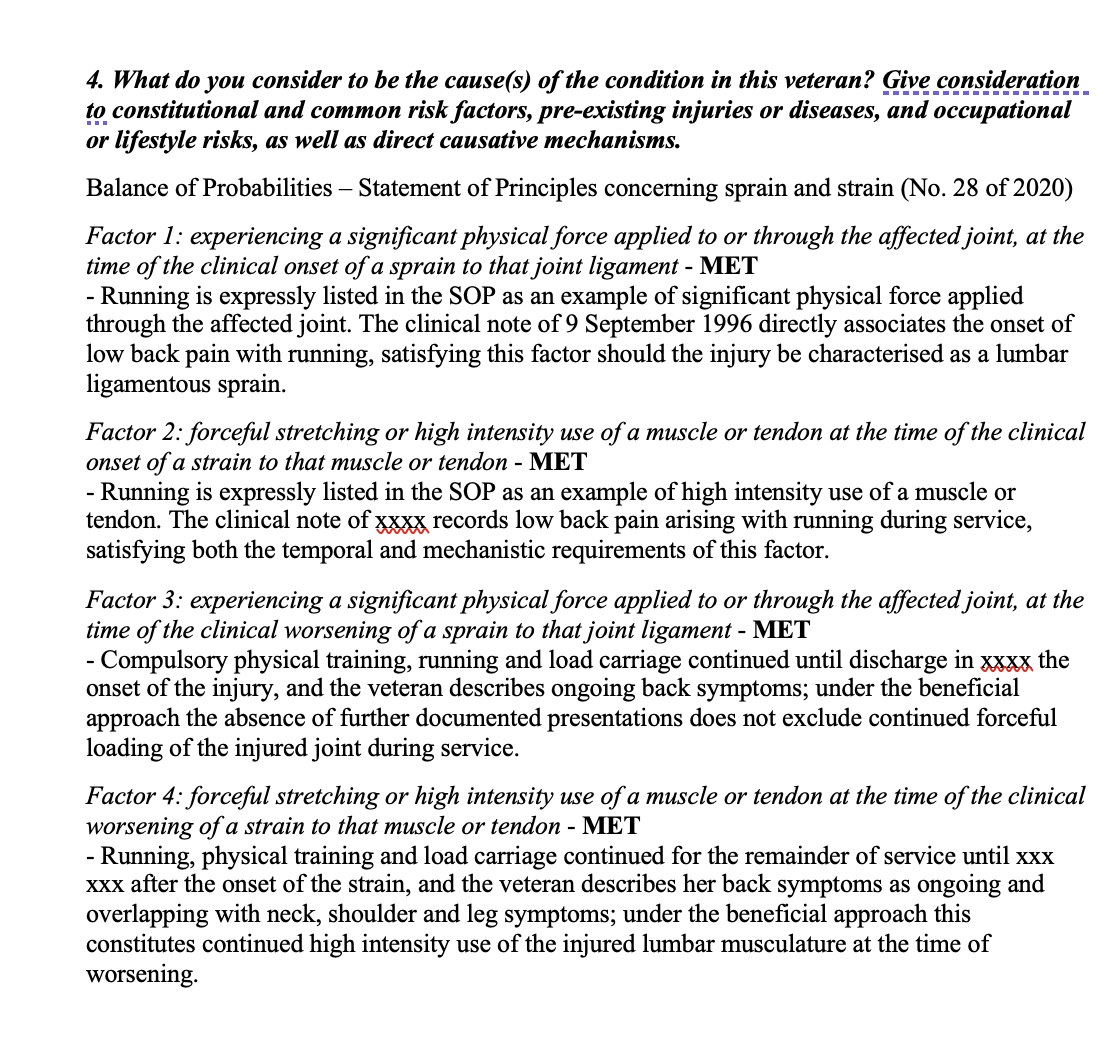
Evidence DVA can accept
Each condition becomes a Diagnostic Assessment: the diagnosis, the referenced timeline, and every SoP factor argued to MET or NOT MET against the exact clinical entry — the document a delegate decides on.
Three of 366 example Diagnostic Assessments — open one and read the report exactly as DVA receives it.
Quality in detail
See, in convenient video format, exactly what one of our Diagnostic Assessments looks like.
366 example claims across 307 conditions — read the actual reports.
Every Diagnostic Assessment we write is the claim itself: the document a DVA delegate decides on. Browse them A to Z by condition, open any report in full and see the SoP factors argued to MET or NOT MET. All examples are fictitious-patient versions of real VHC work.
Affordable, upfront fees
Everything you need to unlock the claims in your medical history and progress your DVA claims in their entirety.
Complete Chart Review
Our doctor will look at every page of your medical documents — backed up with AI.
Diagnosis Forms, Diagnostic Assessments & Evidence Packs
Created for every condition already documented in your medical records.
History, Examination & Investigation
A thorough clinical work-up of any current injuries not yet in your records. (Private MRIs, where required, approximately $320 per scan paid directly to the imaging provider.)
Forms, Assessments & Evidence Packs for New Conditions
Diagnosis forms, diagnostic assessments and evidence packs created for newly identified conditions.
Everything you need to unlock the claims in your medical history — $600–$2,400 + GST, no further fees. Never a percentage of your compensation.
Start with your condition.
Every DVA claim is decided against a Statement of Principles. Open the SoP for your condition to see exactly what it has to prove, or read an example of the Diagnostic Assessment we write for it.
Statement of Principles factors
Example Diagnostic Assessments
- What a DVA claim is
- The 1 July 2026 change: one Act for everyone
- Who can claim
- The kinds of claim you can make
- The claim process, step by step
- What DVA is actually deciding: Statements of Principles
- The evidence that decides claims
- How long claims take, and what slows them
- Conditions veterans claim
- If your claim is rejected
- What it costs
- The mistakes that cost veterans most
- Glossary
What a DVA claim is
A DVA claim is a request for the Commonwealth to accept that an injury, illness or condition is connected to your service in the Australian Defence Force. That acceptance is called initial liability, and it is the gate everything else sits behind.
Once liability is accepted for a condition, three things follow. The condition can be treated at DVA's expense. It appears on your DVA Veteran Card. And it becomes eligible for further compensation — permanent impairment payments for the lasting effect of the condition, incapacity payments where it has reduced your earnings, rehabilitation, household and attendant care support, and in some cases travel for treatment.
Until liability is accepted, none of that is available for that condition. So the first claim is not really about money. It is about getting each condition recognised, one at a time, on the evidence. Everything downstream depends on how well that is done.
It is also worth understanding that DVA is not deciding whether you are injured. It is deciding whether the material in front of it establishes a connection between a named, diagnosed condition and your service, in the specific way the legislation requires. Those are very different questions, and the gap between them is where most claims are lost.
The 1 July 2026 change: one Act for everyone
For decades veterans' compensation ran under three separate Acts, and which one applied depended on when and where you served:
- MRCA — the Military Rehabilitation and Compensation Act 2004, for service on or after 1 July 2004.
- DRCA — the Safety, Rehabilitation and Compensation (Defence-related Claims) Act 1988, broadly covering service before 2004.
- VEA — the Veterans' Entitlements Act 1986, covering wartime and certain operational service.
Many veterans had conditions spread across two or even three of them, with different tests, different benefits and different paperwork for each. It was, by common consent, a mess.
From 1 July 2026, new compensation and rehabilitation claims can no longer be lodged under the VEA or DRCA. Every claim lodged on or after that date is assessed under the MRCA, regardless of when you were injured or when you served. Claims lodged before that date continue to be processed under whichever Act applied at the time, and conditions already accepted under the VEA or DRCA are automatically recognised under the MRCA — you do not need to reapply, and existing payments continue as they were.
The changes went further than simplification — see everything that changed on 1 July 2026, including new Gold Card pathways, presumptive liability and medical events on duty. In practice this simplifies things considerably. If you are lodging today, you are lodging under the MRCA, and the process below is the process that applies to you.
Who can claim
Broadly, anyone who has served: current and former members of the permanent forces and the Reserves, cadets and declared members, and members of peacekeeping forces. Service does not have to have been operational, and you do not have to have deployed. A knee destroyed on a training area counts the same as one destroyed overseas.
Two misconceptions stop more veterans claiming than anything else. The first is that you had to have been medically discharged — you did not; the vast majority of successful claimants left the ADF on ordinary terms. The second is that there is a deadline — for most conditions there is no general time limit on lodging an initial liability claim, and veterans who discharged decades ago lodge and succeed regularly.
What matters is whether a condition can be diagnosed now and connected to service on the available evidence. That is a question about records and medicine, not about how long ago you served.
The kinds of claim you can make
Initial liability. The claim that gets a condition accepted as service related. This is the starting point for everything, and it is lodged condition by condition.
Permanent impairment. Compensation for the permanent effect of an accepted condition, assessed by rating impairment against the GARP guides and adding a lifestyle rating. See our Permanent Impairment Assessments page for how that assessment works in practice.
Incapacity payments. Compensation where an accepted condition has reduced your capacity to earn, paid as the difference between what you earned in the ADF and what you can earn now.
Treatment. Accepted conditions are treated at DVA's expense. Separately, two programs provide treatment without liability being decided at all: non-liability health care, which funds treatment for mental health conditions, cancer and pulmonary tuberculosis regardless of whether they are service related, and Provisional Access to Medical Treatment (PAMT), which provides free treatment for one or more of 20 specified conditions while a MRCA claim is being assessed. If you are struggling now, these are the fastest doors and neither requires you to wait for a determination.
Household and attendant care. Practical help at home where accepted conditions prevent you doing what you used to do — gardening, lawn mowing, heavy cleaning, personal care.
The DVA Veteran Card. Gold, White or Orange depending on your circumstances, determining what treatment is funded and for which conditions.
The claim process, step by step
1. Get a diagnosis for every condition
This is the step veterans skip, and it is the step that sinks the most claims. DVA cannot accept liability for "my back" or "my nerves". It needs a named condition, diagnosed by a qualified health professional, for each thing you are claiming.
The distinction matters more than it sounds. "Back pain" is a symptom. Thoracolumbar spondylosis is a diagnosis with a Statement of Principles attached to it. One can be assessed against the legislation; the other cannot. Claims lodged with symptoms rather than diagnoses generate requests for more information, and that is where months disappear.
2. Work out everything you can claim
Most veterans claim two or three conditions. Most are entitled to claim considerably more.
Your record usually contains far more than you remember: the ankle rolled on exercise, the shoulder strapped up and worked through, the ringing in your ears you stopped noticing, the sleep that never came right after deployment. Each of those, if it can be diagnosed and linked, is a separate claimable condition — and each accepted condition widens what DVA will fund for you afterwards.
This is what a Chart Review is for: every page of your service and civilian medical record read end to end, and every claimable condition identified, dated and sorted with the source pages that prove it. You cannot claim what you do not know is there.
3. Understand what is being tested
Each condition is assessed against a Statement of Principles. More on that below — it is the single most important thing to understand about the system.
4. Lodge
The fastest route is online through MyService, using a myGov account linked to DVA: select Apply now, choose Initial Liability, and list each diagnosed condition. If you would rather use paper, the equivalent is form D2051, one per condition.
Lodge with the evidence attached rather than promising to send it later. DVA's own guidance is blunt about this: provide complete and accurate information, include supporting reports and documents, and respond quickly to requests. Every gap becomes a letter, and every letter becomes weeks.
One shortcut worth knowing: some conditions fall under presumptive liability. If you claim an eligible presumptive condition and supply a confirmed diagnosis from an appropriately qualified practitioner along with all required information, the claim may be determined in under two weeks.
5. Assessment
DVA runs initial checks to confirm it has what it needs, then allocates the claim to a claims support officer who assesses the medical evidence against your service records. You should hear from the Department roughly every 30 days by phone, email, SMS or letter. Answer those contacts quickly — a claim waiting on you is a claim not moving.
6. Determination, then what follows
You are notified of the outcome in writing. Where liability is accepted, DVA completes a needs assessment — a conversation about the supports, services and payments you may need — and permanent impairment can then be assessed for the accepted conditions.
What DVA is actually deciding: Statements of Principles
A Statement of Principles (SoP) is a legislative instrument made by the Repatriation Medical Authority, an independent body of medical and scientific experts. There is one for almost every condition a veteran is likely to claim, and each sets out, exhaustively, the circumstances capable of connecting that condition to service.
The delegate does not weigh up whether service "probably" caused your condition in a general sense. They ask a narrower question: does the evidence show that one of the factors listed in the relevant SoP was met, and that it was met because of your service?
Most conditions have two SoPs, and which applies depends on the nature of your service. Reasonable hypothesis applies to operational, warlike and certain peacekeeping service, and the bar is deliberately low — a hypothesis connecting the condition to service needs only to be reasonable. Balance of probabilities applies to peacetime service, where the connection must be more likely than not. The two versions are not identical: the reasonable hypothesis version usually contains more factors, with easier thresholds inside them. Citing the wrong one, or citing only one where both could apply, quietly costs veterans claims every week.
SoP factors are precise. One might require a specified level of noise exposure over a specified period; another a particular kind of trauma to a particular joint; another a diagnosed condition existing before the onset of the claimed one. That precision cuts both ways: it means a supportive letter saying "in my opinion this is related to his Army service" does nothing at all, because it names no factor for the delegate to accept or reject.
SoPs also cover routes veterans rarely think to claim: aggravation and worsening of a pre-existing condition by service; sequelae flowing from an already accepted condition; inability to obtain appropriate clinical management, where service prevented treatment that would have limited the damage; and injury arising as an unintended consequence of ADF medical treatment.
You can read the full text of every current Statement of Principles in our SoP Library, and the guide Statements of Principles explained works through how factors are argued.
The evidence that decides claims
Once you understand that the SoP is the test, the shape of good evidence becomes obvious.
The complete record. Service medical records from Defence, plus civilian GP files, specialist correspondence, imaging reports, pharmacy dispensing history and hospital admissions. Anything that dates a condition or shows it being managed.
A diagnosis for each condition, made by someone qualified to make it, and recorded as a diagnosis rather than a passing comment.
Investigations where the diagnosis is genuinely in question. Imaging confirms what an examination alone cannot: an MRI showing the disc, the tear or the arthritis converts an argument into a fact. Where private imaging is needed it is usually around $320 per scan, paid directly to the imaging provider.
A Diagnostic Assessment. This is the document a delegate actually decides on. Each one we write sets out the diagnosis, identifies the governing Statement of Principles for both standards of proof, builds a referenced timeline from the record, and argues every factor to MET or NOT MET against the exact clinical entry that proves it — then addresses worsening, sequelae, clinical management and unintended consequences.
Nothing is left for the delegate to infer, because anything they must infer is something they can decline to infer. If you want to see what that looks like before committing to anything, our Claims Library holds 366 example Diagnostic Assessments across 307 conditions, and the examples page has full de-identified reports of every type we write.
How long claims take, and what slows them
Be realistic about timing. For MRCA initial liability claims received over the last twelve months, the average processing time was around 145 days — roughly 99 days with DVA and 46 days spent waiting on information from someone else. Allocation to a claims support officer alone averaged 13 days, and the average age of claims still on hand was around 192 days.
Read those numbers again, because they contain the lesson: close to a third of the wait is the Department chasing evidence that could have been lodged at the start. The single biggest thing within your control is lodging complete.
The claims that move fastest share three features: every condition is separately diagnosed, the evidence is attached at lodgement, and requests for further information are answered within days rather than weeks.
Conditions veterans claim
The pattern of ADF injury is distinctive, and it repeats. Musculoskeletal conditions dominate — lumbar and cervical spondylosis, disc disease, rotator cuff syndrome, internal derangement of the knee, osteoarthritis, plantar fasciitis, and the strains and sprains that later become those things. Then hearing: sensorineural hearing loss and tinnitus, among the most common and least claimed conditions in the country. Then mental health: post-traumatic stress disorder, depressive disorder, anxiety disorder and alcohol use disorder, which travel together far more often than they appear alone. Then sleep apnoea, gastro-oesophageal reflux, migraine, irritable bowel syndrome, and the skin conditions that follow years of sun exposure.
Each of those has its own Statement of Principles and its own evidentiary requirements. Start with your condition:
Two guides go deeper on the areas veterans most often under-claim: hearing loss and tinnitus, and mental health claims.
If your claim is rejected
A refusal is not a verdict on whether you are injured. In our experience most refusals turn on something the delegate could not find rather than something untrue: no formal diagnosis, the wrong Statement of Principles, a factor genuinely met but never demonstrated, or a clinical history never connected to service in writing.
Those decisions can be reviewed, and review is decided on evidence rather than argument. New submissions rarely change an outcome; new evidence does. Time limits apply and some are short, so if a determination has arrived and you disagree with it, get advice quickly. If a limit has already passed, that is not always the end — a fresh claim supported by new evidence can often be lodged for the same condition, and Statements of Principles are periodically reissued, so a factor that did not exist when you were refused may exist now.
See VRB and determination appeals for how a determination is analysed and answered, and the guide your DVA claim was rejected — what now?
What it costs
Lodging a claim with DVA costs nothing. Free advocacy support is available through ex-service organisations, and DVA runs its own claims lodgement assistance on 1800 VETERAN (1800 838 372). If your matter is straightforward and well documented, those services may be all you need, and we will tell you if that is the case.
What is not free is medical evidence. Medicolegal reporting is not funded by Medicare or DVA, which is why we bill privately — a deliberate choice that lets the depth of the report be set by what your case needs rather than by a schedule fee. Every stage is $600 + GST, fixed and quoted in writing before work starts, and payable only once that stage is delivered. A Permanent Impairment Assessment is $1,500 + GST. We never take a percentage of your compensation. Full detail is on the fees page.
The mistakes that cost veterans most
- Claiming symptoms instead of diagnoses. "Back pain" cannot be assessed against a Statement of Principles. A named condition can.
- Claiming two conditions when eight are documented. Every accepted condition widens your treatment entitlement and contributes to impairment. Leaving them out forfeits both.
- Lodging incomplete and filling gaps later. Nearly a third of the average processing time is DVA waiting on information.
- Treating a rejection as final. Most refusals are evidentiary gaps, and gaps can be filled.
- Relying on a supportive letter. If it does not engage an SoP factor, it gives the delegate nothing to act on.
- Waiting to feel "bad enough". The record is easier to reconstruct now than it will be in ten years, and non-liability treatment is available while you decide.
Glossary
MRCA — Military Rehabilitation and Compensation Act 2004. Since 1 July 2026, the Act under which all new claims are assessed.
DRCA — Safety, Rehabilitation and Compensation (Defence-related Claims) Act 1988. Closed to new claims from 1 July 2026.
VEA — Veterans' Entitlements Act 1986. Also closed to new claims from that date.
Initial liability (IL) — the decision accepting a condition as service related.
Permanent impairment (PI) — compensation for the lasting effect of an accepted condition.
SoP — Statement of Principles: the legislative instrument listing the factors capable of connecting a condition to service.
RMA — Repatriation Medical Authority, the independent body that writes the SoPs.
GARP — the Guide to the Assessment of Rates of Veterans' Pensions, used to convert clinical findings into impairment points.
MyService — DVA's online claim portal, accessed through myGov.
PAMT — Provisional Access to Medical Treatment: free treatment for 20 specified conditions while a MRCA claim is assessed.
NLHC — non-liability health care: funded treatment for mental health conditions, cancer and pulmonary tuberculosis without liability being decided.
VRB — Veterans' Review Board, which reviews certain DVA decisions.
Diagnostic Assessment — the medicolegal report arguing each SoP factor to met or not met; the document a delegate decides on.
This page is general information for Australian veterans and is not legal or financial advice. Entitlements depend on your service, your conditions and the evidence available. For official information see dva.gov.au or call 1800 VETERAN (1800 838 372).
Frequently asked questions
What is the difference between a diagnosis form and a Diagnostic Assessment?
The diagnosis form is DVA’s own short form confirming a condition. The Diagnostic Assessment is the report behind it — the Statement of Principles identified, each factor argued to MET or NOT MET, and every finding referenced to the page of your record that proves it. The delegate decides on the assessment.
Can I claim conditions that aren’t in my medical records?
Often, yes. Plenty of service injuries were never formally documented at the time. That is what the consultation, examination and imaging stages are for — establishing the condition now and linking it back to service on the evidence available.
How long does a DVA claim take?
DVA’s processing times are outside our control and vary with the Act and the conditions claimed. What we control is the quality of what is lodged — a complete, referenced assessment gives a delegate no reason to ask for more and send you to the back of the queue.
What if my claim has already been rejected?
A rejection is a document with errors in it, and those errors can be identified and answered. See our appeals page — we analyse the determination and produce the evidence that was missing.
Do you take a percentage of my payout?
Never. Fees are fixed per stage, quoted in writing before work starts and paid on delivery. What DVA pays you is yours.
Related pages
- Guide: how to make a DVA claim, step by step
- Guide: Statements of Principles explained
- Guide: mental health claims — PTSD and depression
- Guide: hearing loss and tinnitus claims
- Claims Library — 366 Diagnostic Assessments
- SoP Library — every DVA Statement of Principles
- Permanent Impairment Assessments (GARP)
- Example reports
- Fees — $600 + GST per stage
- About Dr Thomas Perkins
The four kinds of DVA compensation.
Veterans often think of a DVA claim as one thing. It is four, and they are decided separately — which is why a claim can be accepted and still pay nothing until the next stage is done.
Impairment Points Calculator
Answer the actual GARP criteria as tick boxes and see your combined impairment points, with age adjustment and the Combined Values Chart applied.
1. Liability — the condition is accepted
The first decision, and the one everything else depends on. DVA accepts that a named condition is related to your service. On its own it pays nothing, but it unlocks treatment and every later claim.
2. Treatment
Once a condition is accepted, its treatment is funded — on a White Card for that condition, or on a Gold Card for everything. For some conditions treatment can start before liability is decided.
3. Permanent impairment
Compensation for the lasting effect of accepted conditions, assessed under the GARP and paid as a weekly amount or a lump sum. This is the stage that produces the number most veterans are thinking of.
4. Incapacity for work
Payments where accepted conditions reduce your capacity to earn. Assessed separately from impairment, on different criteria, and frequently not claimed at all by veterans who would qualify.
There are further entitlements beyond these — household services, attendant care, the Veteran Payment and, for some, superannuation or insurance claims that sit entirely outside DVA. Those are worth asking about separately.
Work out your DVA claim yourself.
Four free tools built from the same instruments DVA decides your claim against. No sign-up, no email, no commission — use them and walk away if you want to.
DVA Payout Calculator
Work out the weekly permanent impairment payment from your combined impairment and lifestyle ratings, using the real GARP compensation factor tables.
Presumptive Liability Checker
New for 1 July 2026. Check whether your condition can be accepted without proving the link to service, and see the exact service and onset criteria that apply.
SoP Finder
Find the Statement of Principles for any condition and read every factor exactly as the Repatriation Medical Authority wrote it. All 357 instruments.
SoP Factor Mapper
Pick your condition and work through the actual factors one at a time to see which pathway your DVA claim runs on.
What Else Can I Claim?
Enter the conditions DVA has already accepted and see every condition that lists one of them as a Statement of Principles factor.
GARP Impairment Estimator
See how GARP combines impairment points across conditions, and why every accepted condition counts towards the total.
DVA claims by body area
Every one of the 357 Statements of Principles, grouped by where it affects you. Each area lists the conditions, how many legislated factors each carries, and links through to the full factor text.
- DVA Claims — Cancer & tumours (48)
- DVA Claims — Mental health (16)
- DVA Claims — Teeth & jaw (10)
- DVA Claims — Ears, nose & throat (15)
- DVA Claims — Eyes & vision (14)
- DVA Claims — Back & neck (10)
- DVA Claims — Knees & legs (11)
- DVA Claims — Ankles & feet (10)
- DVA Claims — Shoulders & arms (8)
- DVA Claims — Hands & wrists (5)
- DVA Claims — Hips & groin (6)
- DVA Claims — Head, brain & nerves (28)
- DVA Claims — Heart & circulation (23)
- DVA Claims — Lungs & breathing (13)
- DVA Claims — Stomach, bowel & liver (31)
- DVA Claims — Kidneys, bladder & sexual health (10)
- DVA Claims — Hormones & metabolism (12)
- DVA Claims — Skin (22)
- DVA Claims — Bones & joints (16)
- DVA Claims — Blood & immune system (17)
- DVA Claims — Infections & tropical disease (20)
- DVA Claims — Injury & environmental exposure (12)
DVA claims, by where you are
We see veterans from across the country. The pages below cover who served where, the units behind the injury patterns we see from each place, and how the claim runs if you are not local to the clinic.
By base
By service
DVA Claims — Army · DVA Claims — Navy · DVA Claims — Air Force
Ready to find out what you can claim?
Contact us for more information.